
Dispute or Conflict? How to Tell the Difference (and a 5-Question Diagnostic)
Updated: Oct 15
As a leader, you've likely felt that moment of hesitation: is this just a heated disagreement between respected colleagues, or is the foundation of team trust starting to shift?
What Is the Difference Between a Dispute and a Conflict?
While people often use the terms interchangeably, in organizational dynamics disputes and conflicts are fundamentally different in kind, not just degree:
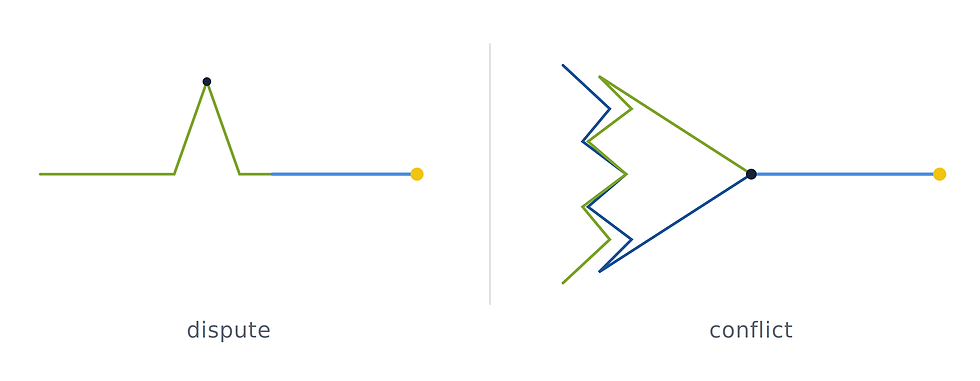
A Dispute (disputare, "to clean up"): A contest over how to answer a specific question. Disputes are disagreements over facts, resources, deadlines, or policy interpretations where trust is still intact and people continue to assume good faith. Because the issue is bounded and transactional, disputes can typically be settled through direct coaching, structured dialogue, or negotiation.
A Conflict (conflictus, "a clashing of swords"): Negative emotions entrenched in a relationship. In a conflict, trust is eroded, and parties actively attribute bad motives to one another's actions. Conflicts are relational rather than situational; resolving individual disagreements one by one will not fix the underlying erosion of trust.
The Core Rule: Disputes are resolved; conflicts must be transformed. Treating an entrenched relational conflict like a simple dispute leads to temporary agreements that quickly fall apart.
Dimension | Workplace Dispute | Relational Conflict |
Root Meaning | Disputare — to clean up / settle a question | Conflictus — clashing of swords |
Core Nature | Transactional, bounded, and situational | Relational, emotional, and systemic |
State of Trust | Intact; good faith is assumed | Broken; bad faith and motives are attributed |
Behavioural Signal | Focused on answering a specific problem | Insisting on winning; continuously generating new grievances |
Organizational Impact | Contained (minor delays, isolated friction) | Spreading (absenteeism, turnover risk, bystander anxiety) |
Approach | Resolution: Coaching, negotiation, or structured dialogue | Transformation: Restorative conferencing or deep trust repair |
At ProActive, we’ve learned that the most helpful thing we can offer leaders is clarity. We’ve developed a brief conflict diagnostic tool to help you distinguish between the two in seconds. It’s a small way for us to support you in building a culture where teams feel capable of navigating their own professional relationships directly and respectfully.
No email, no sign-ups, just a resource to help you find the right path forward.
Take the 5-Question Conflict Diagnostic Tool
Start the shift from conflict to collaboration today.



Comments